

Clean Economy Progress Report: August
Global renewables set to overtake coal, MDBs deploy record $163B in climate finance, UK electric cars outsell petrol, and more.

By Bruce Douglas, CEO Global Renewables Alliance
In this monthly series, I highlight notable examples and markers of renewable energy deployment and global decarbonisation in action, from ground-level implementation to systemic breakthroughs rewriting the clean economy.
Electricity generation from renewables is set to overtake coal in 2026, even as global power demand increases faster than in previous years. The share of renewables in electricity generation is forecast to rise from 33% in 2025 to 37% by 2027.
A record 11.7 GW of global pumped storage hydropower capacity was added in 2025 - surpassing 200 GW cumulatively. Globally, hydropower remains the biggest source of renewable energy, reaching 1,469 GW of capacity in 2025.
In Germany, wind and solar power have overtaken fossil fuels in electricity generation. Together, wind and solar accounted for 44% of the total electricity generation in 2025, compared to 43% from fossil fuels, reflecting the growth of renewables under Germany’s “Energiewende” strategy over the past 20 years.
Australia is experiencing a battery boom, accounting for almost 10% of new global installed battery capacity this March. A total of 600,000 home batteries have been installed in the country – over three times the number installed in California – helping to ease the strain on power systems during peak demand.
Multilateral development banks delivered record climate finance in 2025, increasing funding by 21% to USD 103 billion in low- and middle-income countries. Globally, financing rose by 19% to USD 163 billion, putting MDBs on track to meet their 2030 climate finance goals.
Clean cooking finance in sub-Saharan Africa is scaling, with USD 737 million of the USD 2.2 billion pledged in 2024 already disbursed across nearly 30 countries. This puts the full package on track to be delivered by 2030, according to the IEA.
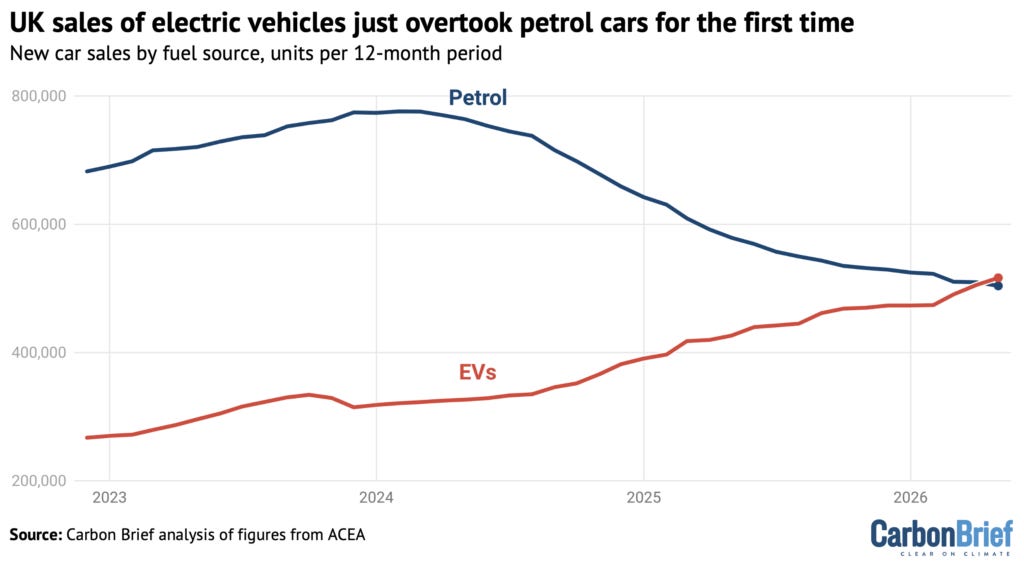
In the UK, sales of electric vehicles have overtaken petrol cars for the first time. Carbon Brief finds that UK consumers bought 516,490 new EVs in the 12 months to May 2026, compared to 504,010 new petrol cars.
Hainan Province, in Southern China, will ban the sale of new fuel-powered vehicles by 2030, according to a newly released provincial government plan. The share of new electric vehicles in the province – the first in China to introduce such a ban – is projected to increase substantially, from less than 24% in 2025 to 45% in 2030.
UK–China green finance cooperation has advanced through the launch of the FTSE CCB Dim Sum Green Bond Index and the publication of a joint transition finance report on climate disclosures and green bond markets.
A full archive of stories from the start of 2026 can be found here. This archive is compiled with support from Zero Carbon Analytics, an international research group providing insights and analysis about climate change and the energy transition.