

Inside China’s supply-side climate plan
China’s climate strategy is fundamentally supply-side. Rather than imposing strict emissions caps, it’s betting that the rapid expansion of clean energy will gradually reshape the energy system.

By Belinda Schäpe
China has just released its 15th Five-Year Plan, setting out the country’s development trajectory for 2026 to 2030, including key climate and energy targets.
The plan strongly supports the continued expansion of clean energy and cleantech industries, sending an important signal to the rest of the world that its energy transition will continue amid the global backlash. But it stops short of translating that momentum into stronger targets to reduce emissions or fossil fuel consumption.
This reflects China’s shifting approach to climate politics to use industrial policy and clean energy development as the main drivers in China’s emissions reduction, instead of restricting emissions targets.
Whether this plan can deliver a continued build out of clean energy and drive down emissions in line with China’s global commitments will determine the global climate trajectory for years to come.
A weaker emissions target
The target for CO2 intensity is the most important climate target in the plan, as it determines to what extent emissions can continue to grow before they must peak at the latest by 2030 in line with China’s international climate pledge made by President Xi.
With expected GDP growth of around 4.5–5% annually, the new 17% carbon-intensity target implies that China’s CO₂ emissions could still increase by roughly 3–6% over the next five years.
This is because carbon intensity fell by only around 12% during 2021–2025, instead of the 18% targeted, leaving the country far off track for its pledge to reduce carbon intensity by more than 65% from 2005 levels by 2030.
The government work report suggests that China missed the previous target only by a small margin, reaching 17.7% reductions 2021-2025, but this seems to be due to a change of the definition. While previous reports on carbon intensity only covered energy emissions, the new definition also includes industrial emissions - an accounting trick benefiting from the huge emission reduction from the cement sector as the real estate sector slows.
The overall result is a policy framework that keeps China technically aligned with its 2030 commitments while still allowing emissions to grow in the near term.
Clean energy expansion remains central
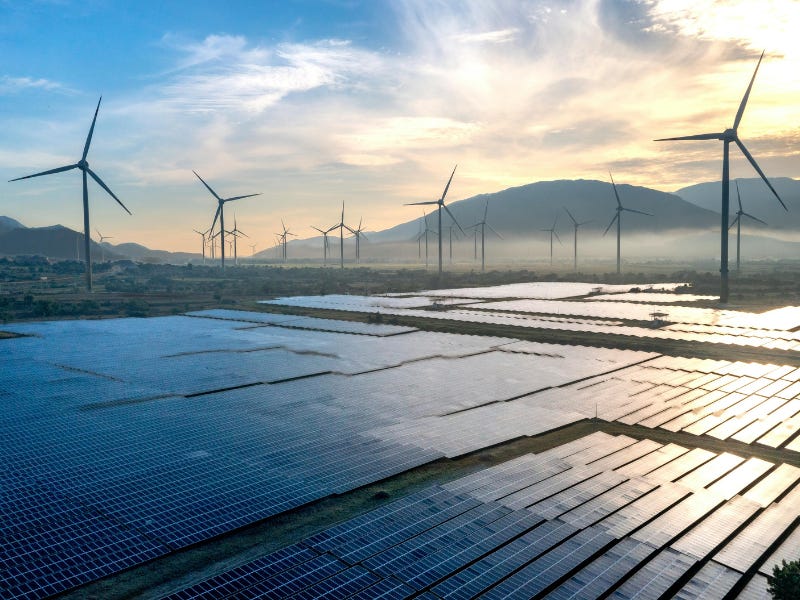
While the emissions target appears cautious, the plan doubles down on the continued expansion of clean energy and closely links it to the country’s economic development strategy.
The plan targets the continued expansion of gigantic clean energy bases, which have been a key driver of solar and wind development during the past five years. The bases include both the northwestern desert bases, which have been most significant in the past five years, and a new emphasis on bases in the southwestern, hydropower-rich provinces, combining solar, wind and hydropower.
The government is also pushing to build a “new type power system” capable of integrating large shares of renewable energy through expanded transmission, smart grids and energy storage. Hydrogen, energy storage and other emerging technologies are also highlighted as strategic industries.
This reflects the core strategy that has defined China’s energy transition so far: scale up clean energy supply at extraordinary speed and allow falling costs and expanding electricity generation to drive the shift away from fossil fuels.
Our analysis suggests that clean energy sectors contributed a third of China’s GDP growth and 90% of investment growth in 2025. Without these sectors, China would have missed its crucial GDP target. This means that going forward, strong clean energy development remains a government priority to ensure that they don’t become a drag on the economy.
Green fuels and the next phase of industrial transition
The next phase of China’s transition will increasingly focus on sectors that are harder to electrify.
The plan places new emphasis on hydrogen and other green fuels, which are expected to play a role in heavy industry, transport and energy storage.
New initiatives such as zero-carbon industrial parks and zero-carbon transport corridors aim to combine renewable electricity, hydrogen and electrified infrastructure to decarbonise industrial clusters and freight corridors.
In political terms, these technologies serve two purposes. They help tackle emissions in sectors where electrification is more difficult, and they support China’s long-standing goal of reducing dependence on imported oil and gas.
Coal remains the unresolved question
At the same time, the plan walks back earlier messaging about reducing coal consumption.
Instead of committing to a decline, the new framework focuses on peaking coal use at some point during the coming five years and improving the efficiency of existing fossil-fuel infrastructure.
This leaves significant uncertainty about the trajectory of coal power and coal-based industries, particularly the coal-to-chemicals sector, which has been a major driver of emissions growth.
What is missing from the plan are clear constraints that would translate the carbon-intensity target into operational limits on coal power generation, restrictions on new coal power capacity, and a plan for retiring old plants. This creates a major risk for China’s coal power fleet to continue expanding, with a record high of new proposals last year, risking not only higher emissions but also stranded assets from low utilisation of these new plants.
Implications for international climate diplomacy
At the same time, China continues to present itself internationally as an active participant in global climate governance.
In a section on providing global public goods, the plan states that “as a responsible major country, China will play a more active role in addressing global challenges such as climate change.” It also pledges to “actively participate in and steer global climate governance,” while emphasising continued South–South cooperation on climate issues.
This shows a continuation of Beijing’s previous approach, but has yet to translate into a more proactive leadership approach in global climate governance. Beijing continues to position itself as a champion for the developing world in multilateral negotiations and presents its clean technology exports as its main contribution to accelerating the global energy transition.
For now, Beijing appears confident that technological momentum will carry the transition forward. The question for the rest of the world is whether that momentum will be fast enough.
A transition driven by supply, not caps
Taken together, the plan confirms that China’s climate strategy remains fundamentally supply-side. Rather than imposing strict emissions caps, policymakers are betting that the rapid expansion of clean energy will gradually reshape the energy system.
That approach could still succeed: renewable energy growth in China is already so fast that clean power is meeting all of the country’s still rapidly rising electricity demand.
But without stronger emissions targets or clearer limits on fossil fuels, the trajectory of China’s emissions over the next five years remains uncertain.
And given China’s role as the world’s largest emitter, those choices will shape the global energy transition for the rest of the decade.
Belinda Schäpe is China Team Lead at the Centre for Research on Energy and Clean Air (CREA) where she analyses China’s decarbonisation journey and advises policymakers on their diplomatic engagement with China.